EPA turns attention to EP water surface cleanup
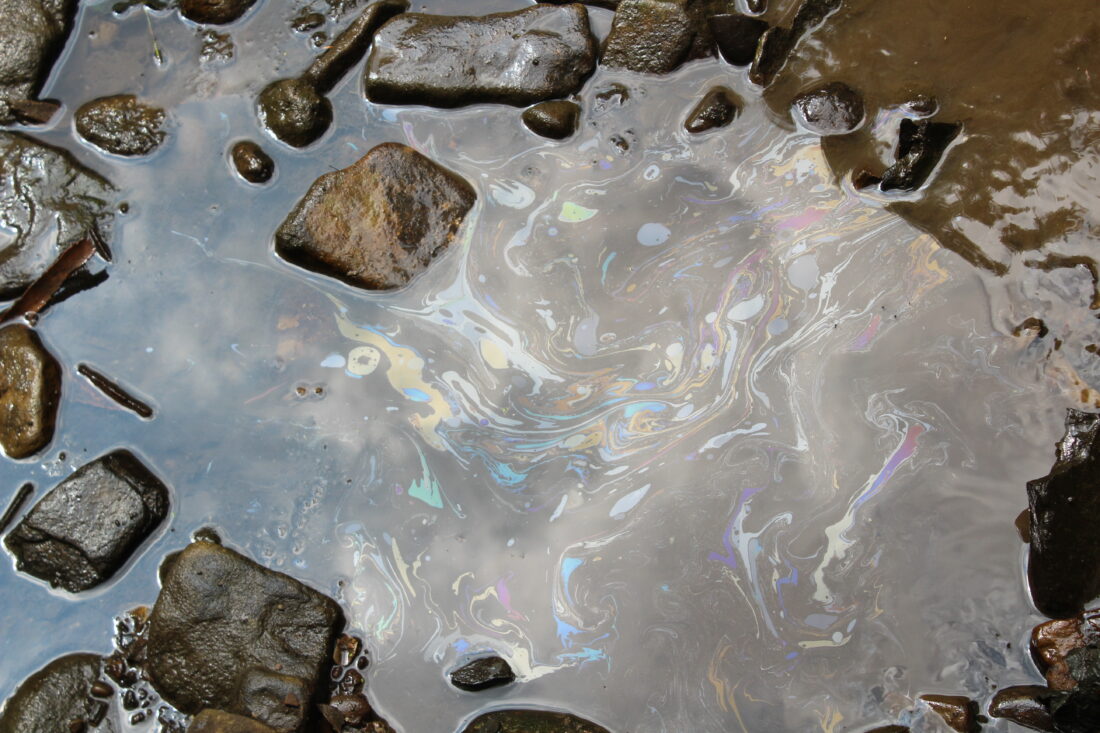
Six months after the Norfolk Southern train derailment, a colorful, chemical sheen was still visible in Leslie Run in August. The sheen has been a concern for residents since the train derailed, and is currently the focus of an assessment being carried out in Leslie and Sulphur Runs. (Photo by Stephanie Elverd)
EAST PALESTINE — With all impacted soil now removed from the site of the Feb. 3 train derailment, the Environmental Protection Agency has turned its attention to the area surface water, reporting on its website that clean-up work on the underground culverts is underway through the village.
Remediation work in the creeks has ramped up since the EPA, under the agency’s EPA’s Clean Water Act authority, issued an order to Norfolk Southern on Oct. 18 that instructed the railroad to conduct additional cleanup and sheen investigations focused on oily sheens and sediments in Sulphur Run and Leslie Run creeks in East Palestine and surrounding areas. The visible sheen in both Leslie and Sulphur Runs has been a concern of residents since the rail disaster nearly 10 months ago.
The EPA has been assessing the sheen since the derailment — first looking for it and now collecting additional samples.
“The qualitative assessment (looking for sheen locations) in Sulphur and Leslie Runs is complete,” the EPA recently reported. “Sediment and sheen sampling at those locations have begun and will continue into December.”
The sheen-scoring process was first explained in the EPA-approved Sulphur Run Characterization Work Plan, released in June and revised in July. The process involves agitating the stream sediment and turning over rocks and then grading sheen uncovered on a scale of 0-3 — 0 being no sheen visible and 3 being heavy sheen. According to Sulphur Run Characterization Work Plan, early sheen-scoring within Sulphur Run reflected heavy sheen with no areas of the creek scoring a zero and all areas graded 2 or 3.
As for the culverts and assessing parts of the creeks, specifically Sulphur Run, that flow underground, the EPA is utilizing advanced technology. That technology includes an autonomous, quadruped (four-legged) robotic dog, known as “Mudge,” which was developed by Boston Dynamics.
“Drones and robots are used to access, survey and monitor the culverts. A remote-controlled robotic dog can enter the culverts to take pictures and check air quality,” the EPA said. “Once the initial culvert survey and safety assessments are complete, sediments and some debris will be removed.” The use of “Mudge” and the drones are the latest tactics to get a better understanding of what contamination exists underground. The Sulphur Run Characterization Work Plan first addressed the need for such an assessment. The work plan noted three covered sections of the creek totaling 1,000 feet that were yet to be characterized in June. The plan cited “access limitations and health and safety/confined space considerations” as the reasons for the lack of characterization, explaining that the underground portions would be examined using a remotely-operated camera system and a tethered-raft.
Remediation in the impacted creeks has been ongoing since the derailment. The waterways have undergone oxygenation and air-knifing (a process where air is injected into the sediment to liberate anything under the sediment and bring it to the surface to be later collected by a booming system downstream), as well sediment washing and high-pressure washing of the culverts in an attempt to remove contaminated sediment in the culverts that was suspected of contributing to indoor air odors in some area homes and businesses.
Sediment sampling and pore water sampling — a process the EPA describes as collecting water from sediment using a peristaltic pump or a syringe — have also been conducted as part of the surface-water assessment.
“Over the summer, stream assessments were done to determine if there were remaining impacts to the streams from the derailment,” the EPA reported in its latest derailment newsletter. “Contamination was found in some areas and the current work is meant to clean out culverts and get more detail on what remains in the sediment to inform any future cleanup plans that might be necessary.”
While the EPA has repeatedly said that the condition of the waterways has been steadily improving, derailment-contaminated chemicals were detected as late as August. The agency reported that sampling data from February to August detected acrylates, toluene, acetone, glycols, benzene, vinyl chloride, and PAHs (Polycyclic Aromatic Hydrocarbons) in the creeks.
In other derailment news, the EPA reported that “sampling results from the on-site wastewater treatment system continue to show treated wastewater can be disposed of off-site as non-hazardous” and that “winterization measures will make sure the wastewater treatment system can operate in colder temperatures.”
The EPA also reported that site operations will be reduced during the week of Thanksgiving and reminded residents that the Norfolk Southern Family Assistance Center will be closed during the week of Thanksgiving.
Local News

East Liverpool High School Scholar of the Month
East Liverpool City Hospital achieves national status as a Straight “A” for patient safety
EAST LIVERPOOL — East Liverpool City Hospital a member of Prime Healthcare Foundation was awarded an “A” ...
Calendar
THU/5-7 Alliance Kids Crafting program, 4 p.m., Rodman Public Library Beloit West Branch Athletic Boosters ...

Beaver Local seniors recognized for outstanding academic achievement
McKinley students launch “The Trojan Coffee Cart” to earn “Ohio Means Jobs” seal