
New facility recommended for Sebring Library
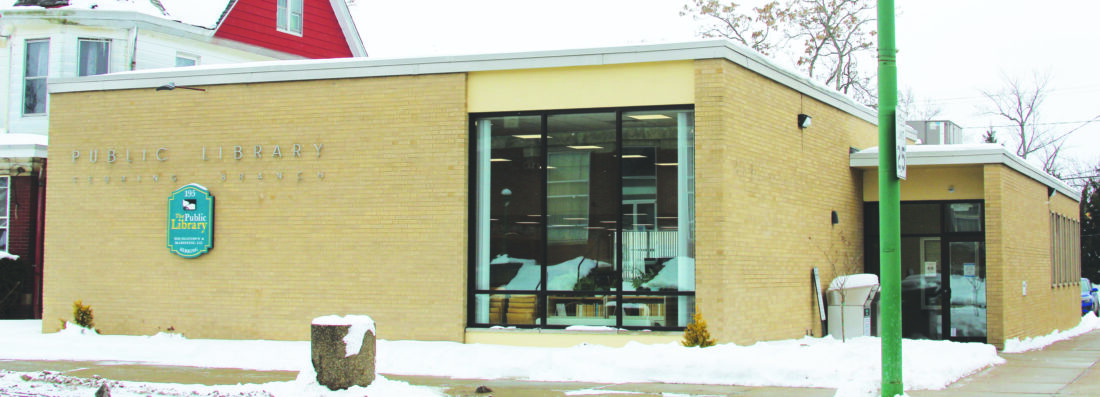
The current home of the Sebring branch of the Public Library of Youngstown and Mahoning County (PLYMC) at 195 W. Ohio Ave. was first built in 1964 as a post office before being repurposed. However, the PLYMC’s 10-year facilities master plan recommends the branch be relocated to a larger property which could accommodate study and meeting spaces among other facility upgrades which wouldn’t fit inside its current footprint. (Photo by Morgan Ahart)
SEBRING — The Public Library of Youngstown and Mahoning County (PLYMC) 10-year facilities master plan recommends the relocation of its Sebring branch.
Released on Jan. 20, the facilities master plan contains facility assessments and recommendations for each of the branches including Sebring, as well as the main library in Youngstown and PLYMC’s community engagement department.
The plan recommends relocating the Sebring branch “to a new site which will support the Sebring community” with an estimated total implementation cost of $4.9 million, stating that its current location isn’t large enough to complete the necessary expansions to the building to install “meeting spaces and dedicated study rooms” which were determined to be “critical programs for [the] community.”
“It is recommended that this branch be replaced with a new branch library in a new location. A new, standalone branch will enable the library to continue providing a high level of service with improved visibility and accessibility while significantly reducing maintenance costs,” states the report.
Other recommendations listed for the Sebring branch include: providing study rooms/smaller meeting rooms; creating access to outdoor reading spaces or a reading garden; providing a meeting room sized to support community programming; improving visibility and accessibility; and providing an enhanced business center & computer area.
However, the recommendations within the plan are just that, recommendations.
The development of the full 174-page page master plan was led by architectural and design firm Bialosky with additional consultation by Library Strategies and was completed over the course of roughly 18 months, drawing upon internal and local statistics and data, as well as patron, community, and staff feedback.
“This report looks at the library’s entire system of facilities and makes recommendations over the next 10 years. Each one of these recommendations is subject to a board of trustees approval process, as well as budget limitations and funding priorities,” said PLYMC Chief Stakeholder Relations Officer Zak Kozberg.
Those recommendations are “analyzed and reviewed by PLYMC Leadership as well as the Board of Trustees” who will decide if and how to put those recommendations into practice. Kozberg said that they haven’t decided on anything yet.
“No decision on any recommendation with the Facilities Master Plan has been made,” said Kozberg.
According to the plan, the Sebring branch, which is located at 195 W. Ohio Ave., had the third lowest attendance of all 13 branches in 2024 with 13,657 visits for 4.2 visits per square foot, and a circulation of 19,128 items for 5.88 items for square foot. Of the current building’s 4,029 gross square feet, 3,255 square feet are classified as occupiable space. The space balancing analysis lists 82% of the building’s space as being dedicated to collection materials or open with the remaining 18% dedicated to staff or support space.
The facilities assessment summary states that the current “public and staff restrooms are not compliant with [the Americans with Disabilities Act] and would require significant demolition and reconstruction” to become compliant. Plumbing more broadly was also identified as a point of concern as “the plumbing systems are older and in need of repair and/or replacement” with the “most immediate issues” identified as: the electric water heater needing replaced, “regular issues with the sanitary main that need to be investigated and corrected,” and the lack of “code-required insulation on the exposed piping below the public lavatories.”
The assessment states that the electrical system is also “in poor condition,” noting that “the main distribution panel has limited spare capacity,” and that “several distribution panels are original and should be investigated for safety concerns and look to be replaced in the near future.” The building also lacks fire sprinkler or a fire alarm system and is not equipped “with any sort of emergency power.” The total estimated implementation cost of all recommended facilities projects at the current building is $977,308.
Local News

More than 70 grams cocaine found in DTF warrant execution
Chester man charged with abduction, felonious assault and grand theft of motor vehicle
EAST LIVERPOOL — Jessy Lee, 35, Chester, Virginia, is currently being held in Huron County Jail awaiting ...
Republican candidate for Mahoning County auditor withdraws
YOUNGSTOWN — Republican Zachary Miller withdrew as a candidate for Mahoning County auditor. Miller’s Tuesday ...
On the calendar
THU/2-19 Beloit West Branch Athletic Boosters bingo booster hall, 26701 U.S. Route 62. Doors open at 4:30 p.m., ...
Ohio Foothills region to market Appalachian Ohio as a tourist destination
LISBON — A new regional tourism brand, Ohio Foothills, has officially launched to market a multi-county area of ...
Quakertown Trolley Tour
The Quakertown Trolley Tour, scheduled for 2 p.m. on Sunday, Feb. 22, will transport passengers back to the late ...