
Baseball helps keep soldier’s memory alive
Trending
SALEM -- His Varsity "S" letter was earned on the Salem High School track team but when he graduated in 1940, Ernie Hrovatic had one thing on his mind: Baseball.
Three short years out of high school, Hrovatic was looking at a "sure fire" shot at the majors. However, in what can hardly be described as anything other than a moral decision, he left home to serve his country.
Ernie was one of the very highly-regarded Hrovatic family of athletes, and one of five who graduated from Salem High School after the family moved here from Calumet, Mich.
After high school, Hrovatic wore the minor league uniforms of Boston Red Sox and the St. Louis National Baseball Club farm teams from 1941 through 1943.
He'd been deferred from his first army draft call due to high blood pressure. But also recall that baseball -- the nation's most popular sport -- reached deeply into American life from faraway big league stadiums to nearby sod fields carved from rural farmland where young players nurtured dreams.
From the beginning of the war, at all levels, baseball diamonds remained in action because President Franklin D. Roosevelt's finger was on America's pulse. His keen intellect understood the vital importance of keeping morale high.
Carefully and calmly easing the nation into the interminable darkness of world war, Roosevelt ordered that across the land two words would continue lifting the country's spirit: "Play ball!"
And by late 1943, as pressure for manpower increased during the Arsenal of Democracy's unprecedented arms buildup -- along with the battlefield demand for soldiers and sailors on two enormous, ever-widening fronts soared -- life changed dramatically for young men and women.
Hrovatic played ball in 1941 and during the first two war years of 1942 and 1943 with his medical deferment. But he, like Roosevelt, understood too.
Hrovatic was playing for the St. Louis Cardinals' Jamestown (NY) Falcons where he earned the name "Solid Folks" and had a stellar Pony League season with the Falcons coming within "an ace," sportswriter Waite Forsyth said, of capturing the league batting title.
Forsyth covered the Falcons and called Hrovatic the Falcon's "star right fielder" as he wound up with a .336 batting average while leading the league in doubles and RBIs.
Veterans in the St. Louis organization said Hrovatic was "sure fire" for a regular outfield slot in their Pacific League team.
"Becoming a member of the Coast League was one of Ernie's life-ong dreams …" Forsyth wrote.
But the other matter came up.
Ernie's second draft call came in late 1943.
Forsyth announced to Falcon fans in a sports column that Hrovatic "was received with open arms on answering his second invitation, although there was no change in his condition. His was a border line case, so much so that Ernie was given his choice of joining up or remaining at home."
Only a sports writer could turn a draft notice into an "invitation" but since the draft board left the decision to Hrovatic, it's hard to escape the moral reckoning inside his 21-year-old mind.
"Anyone who made Hrovatic's acquaintance during baseball season here knows what Ernie's answer was," Forsyth said: "Realization of that dream must now be deferred."
Swapping baseball duds for army green, Hrovatic joined up on Dec. 4, 1943. Right hand raised he swore allegiance to America.
The future promise and dreams he built not only slipped away, but were imperiled.
After three short, fabulous years of hard-played baseball, Hrovatic cast his fate to fight for his country and a promising baseball career disappeared into boot camp.
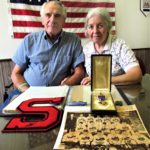
Hrovatic's younger brother, Jim, and his wife, Barbara, built a scrapbook, assembled old, worn baseball letters, yellowed newspapers clipping and Ernie's army medals.
Everything is aged but well kept.
There were 13 Hrovatic children and five attended Salem High School after the family moved to Ohio from Calumet, a copper mining town in Michigan's upper peninsula.
The boys were all known for their athletic abilities and played baseball on merchant-sponsored teams.
Ernie played intramural basketball and was on the Salem High School mile relay track team, earning a letter.
Barbara Hrovatic said there were enough Hrovatic kids to play baseball "just in the family."
"They played on farm teams, on the farmer's fields … and that's why baseball was so popular," she added. "In the 1930s his family was known as a baseball family. They all played and they had a team just in the family, even the girls and his mother would play with her children. They did not always have bats and a ball, but a good stick and a stone worked.
The Boston Red Sox had the 17-year-old Hrovatic lined up.
Specifically, team scout Fred Hunter had his eye on Hrovatic and in 1939 wrote him, "I hope to see you in the big leagues some day."
Hrovatic signed with the Centreville Baseball Club right out of high school (with the written consent of his parents) and played for a $100 signing bonus and $75 a month.
He was assigned to the Red Sox Danville, Va. club in 1941 and again, after a $100 signing bonus, he was paid $75 a month.
"You understand how to report? Just travel as cheaply as you can and keep a list of what you spend and the club will reimburse you on arrival," Hunter wrote.
Jim Hrovatic thinks back.
"When you think about a poor country boy -- the whole family, he was like the hope of the whole family. We were so poor," he said.
On Oct. 13, 1941 , Herb Pennock, the director of minor league clubs for the Red Sox who pitched on the famed 1927 Yankees of Ruth and Gehrig, wrote Hrovatic saying he would advise him which club to report to for spring training in 1942.
"Your season this past summer in semi-pro has done you a lot of good and for that reason I'm going to give you the opportunity to start again with us next year," Pennock wrote.
Hrovatic was assigned the Owensboro (Ky.) Club in the Kitty League, a Class D team and after a handful of games signed on with the St. Louis Cardinals who farmed him out to the Class D Penn State Association Washington Redbirds.
"I played American Legion ball, played two years, in the outfield but I played for fun. Rudy, Ernie, Joe, Carl and John, they played to win," said Jim. He added that his other brother, Ralph (Jiggs), also played for fun.
While his was knocking on the big league door, back in Salem during the off season, Ernie, who earned A's and B's in school, worked at Mullins Mfg. and earned the Army-Navy "E" production award for excellence in war production. It was dated April 15, 1943.
That summer he enjoyed his great season with the Falcons, just missing the batting title.
"If you wanted to be good you had to work at it," Jim said, recalling the brothers played at Idora Park and with the Lisbon Eagles.
Ernie wound up in the infantry and worked his way overseas to Italy and eventually wound up with in the 36th Armored Infantry Regiment (AIR) attached to the 3rd Armored Division that fought across France and Belgium.
His fateful day was Jan. 14, 1945, six weeks after Battle of the Bugle started in the Adrennes Forest.
American forces suffered their highest casualties of any operation during the war and Ernie Hrovatic, Salem High School class of 1940, was one of them.
He was killed in action at Ottre, Belgium.
Days later, Jim explained, the telegram came.
"There was a knock on the door," he said explaining that the person delivering it had to trudge a mile uphill through deep snow to get to the back door of the McCracken Road RD #3 residence.
"He gave me the telegram and I gave it to mom and she read it, moaned and fainted," Jim said.
"That's something you never forget."
Ernie was awarded the Purple Heart, Combat Infantryman Badge (CIB) and Good Conduct Medal for (Efficiency, Honor, Fidelity), American Campaign Medal and the World War II Victory Medal.
When his personal effects were returned, Barbara said there was blood on Ernie's CIB.
He is buried in Henri-Chapelle American Cemetery in Hombourg, Belgium and the family wondered if that was the right thing, to be buried there.
Jim and Barbara visited his grave in the 1990s.
"You sit there and saw all those men, his comrades,: Barbara said. "He was where he should be. You realize there's a price to pay. You realized he probably wanted that.
"He had not gotten married. He was single and would have wanted to be with his comrades. That's where he should be."
His grave marker is B-4852 and says: ERNEST HROVATIC PFC 36 INF 3 ARMD DIV, OHIO JAN 14 1945.
"He gave everything for his country," Jim said. "He could have been a professional ball player."
lshields@salemnews.net