
ACROSS THE NATION
Trending
Native American women made history in tribal, state and federal elections
ALBUQUERQUE, N.M. (AP) -- A third-grade field trip to the Navajo Nation Council sparked Crystalyne Curley's political ambition when she witnessed a fiery debate erupt between two tribal lawmakers.
"I thought to myself at a very young age, that's where I want to be," Curley said.
On Election Day, Curley surpassed that childhood dream and broke a barrier she says she never imagined as a nine-year-old: She was elected the first woman president of the Navajo Nation.
This week's elections brought a wave of milestone victories, from the nation's first Black female governor to the first openly gay man and first Muslim elected to the U.S. Senate. It also marked a turning point for Native American women, whose leadership in their families and communities has rarely translated to formal political power.
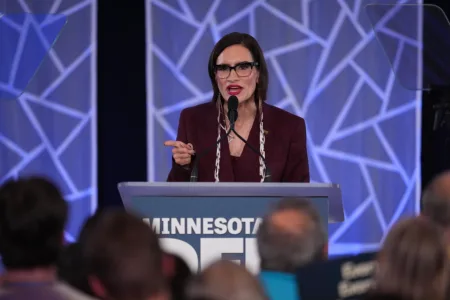
Peggy Flanagan became the first Native American woman elected to the Senate, Deb Haaland the first to win a state governorship, and Curley the first to lead one of the largest tribes.
"This is a win for all Navajo women," Curley told The Associated Press.
Jordan James Harvill, a Cherokee Nation citizen and strategist with the advocacy group Advance Native Political Leadership, said decades of political organizing are bearing fruit as more Native women run for and win office.
"This is a seismic shift that is happening in our communities," he said.
Lene Bitsui supported Curley in the Navajo Nation election because she felt she was best positioned to restore order to the tribal government after what she sees as a period of dysfunction. But when Bitsui cast her ballot, she felt pessimistic.
"I thought our people weren't ready for a female president," Bitsui said. "I was wrong, and I feel so happy to have been wrong."
The modern, centralized Navajo government has been led by men since its establishment under federal pressure over a century ago. Navajo has the largest land base of any federally recognized tribe, spanning 27,000 square miles (70,000 square kilometers) in Arizona, New Mexico and Utah, and is second in population to the Cherokee Nation in Oklahoma.
Some Navajo people believe traditional teachings prohibit women from holding top government positions. Others say women's absence from the presidency stands in contrast to the matrilineal structure of Diné society.
"You see the language of tradition used to both deride the possibility of a woman being president and to say that women's leadership is needed now," said Jennifer Nez Denetdale, a professor of Diné studies at the University of New Mexico.
US military says it fired on commercial vessel in Gulf of Oman after it attempted to breach blockade
JERUSALEM (AP) -- U.S. Central Command said late Saturday it disabled a St. Kitts-flagged ship after it ignored multiple warnings and attempted to leave the region after visiting an Iranian port.
U.S. forces have been enforcing a naval blockade on Iran for months in and around the Strait of Hormuz, a crucial strategic waterway for global shipping, including of oil. The last confirmed U.S. strike on a cargo vessel was nearly a month ago in the Gulf of Oman.
Saturday's disclosure comes in the wake of at least two instances in which U.S. Central Command did not announce military strikes it has taken in the region and officials at the command declined to confirm strikes when asked about local reports of explosions.
Iran state media also reported on Saturday evening the sound of explosions on Qeshm Island in the Strait of Hormuz, as well as several explosions in the port of Jask. It wasn't immediately clear what the cause of the explosions was and the U.S. military didn't immediately respond to an Associated Press request for comment.
The Iranian military said late Saturday that two tankers had hit mines in the Hormuz area and caught fire. It did not identify the tankers' flags or destinations.
U.S. President Donald Trump said Friday that the U.S. military had carried out new limited strikes against Iran, targeting an Iranian air defense system. Trump described the military action to reporters as "minor." U.S. Central Command ultimately didn't comment on the action even after the strikes were confirmed by Trump.
For weeks now, Trump has said he was considering launching a new wave of strikes on Iran after the U.S. midterm elections, which were held on Nov. 3. The Middle East and beyond have been on edge about the prospects of the U.S. resuming full-scale operations against Iran for the first time in almost two months.
The more than 8-month-old war has rattled global markets and diplomacy to end it has stalled. October saw the most attacks on commercial ships in the Strait of Hormuz since March, as Iran has tried to ramp up economic pressure on the U.S. to get it to lift its blockade.
Staff at the US center for AI safety are reporting to the White House, raising independence concerns
SAN FRANCISCO (AP) -- With public anxiety growing over mounting reports about out-of-control artificial intelligence agents, the tiny U.S. government division charged with assessing the safety of new AI offerings lacks a permanent leader and has stopped publishing its research.
Officials with the Center for Advancing Innovation and Standards for Super Intelligence, or CAISSI, an independent division of the Commerce Department, recently were asked to informally report to an office of the White House. That's according to two former government officials with knowledge of the ongoing conversations who spoke to The Associated Press on condition of anonymity to avoid repercussions for current staffers.
The new arrangement concerns some critics, who worry that the executive branch might be politicizing decisions that could affect everything from cybersecurity to bioweapons and that the center's findings could be altered or muted in deference to the tech industry, which has been largely entrusted to police itself.
"These are really powerful institutions that can drastically improve our lives, or the alternative. And the hope is that you can put in nonpartisan or bipartisan technocratic experts to enact policy in a way that best serves the American public," said Caroline Siegel Singh, an AI and emerging technology program manager for the Federation of American Scientists.
Others argue that bringing AI safety officials closer to the orbit of President Donald Trump, who has taken an outwardly hands-off approach to the issue, could give the division more prominence -- and perhaps more funding.
The center, which has experienced departures and until recently was called the U.S. Center for AI Standards and Innovation, is allocated $10 million per year. That's about one-eighth the annual budget of its counterpart in the United Kingdom, which is far less celebrated for its frontier technologies.
In April, the division's director was hired and then fired within days. His replacement lasted a few months before he resigned, and the center has been without a permanent leader ever since, although the head of its parent institute doubles as its acting director.
In August, Congress started asking why the center suddenly stopped making public its reports about how safely certain AI systems were performing. San Francisco giant OpenAI also had chimed in by then, asking policymakers to throw more money and support behind the division.
The White House didn't respond to specific questions about CAISSI. But it said in a statement that Trump had formally established his new Super Intelligence Force -- the president's preferred term for artificial intelligence. Trump has commissioned a report on risks from his Council of Advisors on Science and Technology, and will ensure "continued U.S. leadership on SI for the benefit of the American people," the White House said.
Police make arrest in a deadly shooting at Winston-Salem State during homecoming weekend
Authorities on Sunday arrested a man in a shooting during homecoming weekend at Winston-Salem State University in North Carolina that left one person dead and at least one other person injured.
Winston-Salem police said officers who were on campus for homecoming events heard gunshots around 9:45 p.m. Saturday. They found a 19-year-old man with a gunshot wound. They rendered aid but the man died at the scene.
A 22-year-old woman who had what appeared to be a gunshot wound was taken to a hospital, where she was treated and later released.
Assistant Chief Jason Swaim said at a news conference the investigation led to Ziyaire Spinks, 20, who was arrested and being held without bond on charges of murder, assault with a deadly weapon and possession of a firearm on educational property.
According to police, the shooting stemmed from an argument between two groups of people. They confirmed Spinks was not a student at the university.
A second shooting on campus happened less than an hour later, with police responding when they heard shots. In that case, Swaim said two people were injured when gunfire erupted following an altercation.
Authorities said they were investigating to determine if there was any connection between the two shootings. No arrests have been made in the second case.
Chief William Penn, Jr. of the Winston-Salem Police Department vowed during a news conference that authorities will find all of those responsible for the violence at the school.
"It's important that the blame of these tragic events go to the right people and that's the folks who committed these acts," he said, asking people not to point fingers while the investigation is ongoing.
University officials canceled the remainder of homecoming activities Sunday, saying instead that a local church planned to lead a call for prayers in support of the community.
Floods bring rare relief to US Southwest reservoirs as Lake Powell rises 20 feet
PHOENIX (AP) -- Recent flooding across the U.S. Southwest is providing rare relief to thirsty reservoirs that had fallen to record lows amid a yearslong megadrought.
Storms in late October and early November sent torrents of water through normally small or dry creeks that overflowed their banks and flooded local communities.
Hundreds of people were told to evacuate, and the flooding cut off access to some areas. Yet most of that water will end up feeding depleted lakes and underground aquifers, said Martin Hoerling, a climate scientist and hydrologist at the University of Colorado, Boulder.
"That's somewhat of an unexpected boost from Mother Nature," Hoerling said.
Last winter's lackluster snowfall did little to recharge water bodies when it melted in the spring and summer, when they typically get their biggest bump of the year.
Then came the chaotic climate phenomenon, El Niño, that has intensified heavy rain and floods. Experts say its impacts will last several more months, potentially further boosting water supplies across the West where water primarily is stored in lakes, aquifers and snowpack.
Lake Powell, the second-largest reservoir in the U.S., rose more than 20 feet from its mid-September low -- dwarfing its gains from this year's snowmelt, Hoerling said. Still, the lake remained just over a quarter full, and 15 of its 17 boat launches remained unusable as of Friday.
The floodwaters and additional rain could raise the lake along the Arizona-Utah border further, for a total of over 1.2 million acre-feet -- enough to support around 4 million average families for a year, Hoerling estimated.
Cities in the region reported some of their wettest weather in decades.
Before storms began dumping about 7 inches of rain around Pagosa Springs, Colorado, in October, more than 10,000 people in the town and surrounding communities were under water restrictions. Restaurants were encouraged to serve water only on request, town manager David Harris said. Those restrictions are now lifted.
'Godzilla Minus Zero' stomps to a record-setting $31.6 debut, clobbering 'The Cat in the Hat'
NEW YORK (AP) -- "Godzilla Minus Zero" stomped into movie theaters with a chart-topping $31.6 million over the weekend, scoring a record debut for a foreign-language film at the North American box office.
Takashi Yamazaki's sequel to 2023's Oscar-winning "Godzilla Minus One" easily thrashed Warner Bros.' animated "The Cat in the Hat" movie. That film, featuring the voice of Bill Hader, opened with $20.5 million, according to studio estimates Sunday, plus $10 million overseas.
While Godzilla recently celebrated his 72nd birthday, Yamazaki has revived one of the longest running franchises in movies by bringing the series back to its Japanese roots. The film, produced by Toho and distributed in North America by GKids, is set in post-WWII Japan.
No live-action foreign language film has had a bigger opening weekend, unless you count 2004's "Passion of the Christ," which opened with $83.8 million despite its largely Aramaic dialogue. Last year, the anime "Demon Slayer: Infinity Castle" debuted with $70.6 million.
But "Godzilla Minus Zero" bested the mark for live-action previously held by 2004's "Hero" (a $17.9 million launch) and added to the trend of international, non-English productions drawing American audiences to cinemas.
The weekend also saw the widest North American release for an Indian film. "Ramayana: Rise of a Legend, is a Hindi-language epic of Indian mythology that, as part one of two, is the most expensive Indian film ever made. Distributed by Sony Pictures in North America, it launched with $8.7 million domestically and $32 million in India.
"Godzilla Minus Zero" and "Ramayana" were both given global releases, debuting in their home countries at the same time as they reached American audiences. In Japan, "Godzilla Minus Zero" grossed about $17 million over the weekend.
"This historic opening shows how deeply audiences around the world connect with Godzilla and with Takashi Yamazaki's vision," said Koji Ueda, president of Toho Global, in a statement. "Our first near-simultaneous global release was built on that belief."