
ACROSS THE NATION
Trending
Iran's gas lines are growing, but there's no sign so far that its leaders will bow to US sanctions
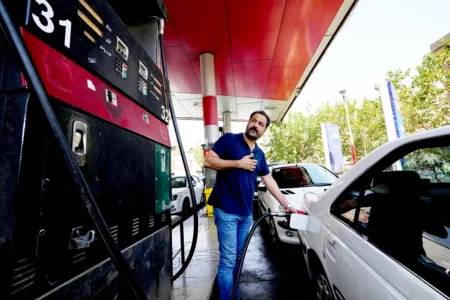
DUBAI, United Arab Emirates (AP) -- Lines have grown outside gas stations across Tehran in recent weeks as the United States has tightened its blockade and threatened more severe sanctions, with some people waiting for two hours or more to fill up.
The uncertainty deepened on Tuesday, after U.S. Treasury Secretary Scott Bessent vowed to fully sever the country from the global economy. In recent days, Iranian officials have spoken of a possible reduction in heavy gas subsidies as they seek to endure the tightening blockade.
"Maybe we will face a shortage of fuel," said Hashem Abadi, a 34-year-old barber. "I rush to the filling stations whenever my tank is down to half or so."
The latest U.S. measures are aimed at wringing concessions from the Islamic Republic nearly six months into the war launched by President Donald Trump and Israel. The war has already battered Iran's economy and inflicted mounting pain on ordinary people. But there's no sign yet that it has brought Iran's leaders to their knees, or that it will reignite the anti-government protests that convulsed the country in January.
The lines had been growing longer well before Bessent's announcement, amid shortages caused by the American blockade and existing sanctions. And with double-digit inflation and the rial currency at a record low, Iranians are struggling to afford more than just fuel.
"I'm filling my car as much as possible since soon it will be sold at higher prices," said 51-year-old taxi driver Mahmoud Chavoshi. "Everything I buy has grown more expensive over the last week, from milk to pasta."
There were no such lineups outside banks, and grocery stores and pharmacies are still well-stocked, but customers complained about being able to afford less. Inflation has soared during the war, and the currency hit a record low ahead of Bessent's announcement.
"Some of our regular customers buy now and pay later, since their pockets are not as full as before," said Morteza Daryani, who runs a grocery store in Tehran.
Iran's President Masoud Pezeshkian accused the U.S. of resorting to economic pressure after failing to defeat Iran militarily. He said it was trying to create "social problems and economic dissatisfaction in order to throw Iran into chaos."
"Should we bow down to the problems and surrender? Absolutely not," he was quoted as saying by the semiofficial Fars and Tasnim news agencies.
Federal judge rejects Ghislaine Maxwell's 'miscarriage of justice' claims and bid for prison release
NEW YORK (AP) -- Ghislaine Maxwell's bid to overturn her sex trafficking conviction and be freed from prison was rejected by a federal judge Tuesday who said the claims by Jeffrey Epstein's former girlfriend and longtime associate that new evidence had emerged were "demonstrably meritless."
Maxwell filed a habeas petition last December seeking to set aside her conviction and free her from a 20-year prison sentence, claiming exonerating information was withheld and false testimony presented at her trial, resulting in a "complete miscarriage of justice."
Judge Paul A. Engelmayer rejected her arguments, saying in his written ruling they "all or almost all are frivolous" and that she had presented nothing that could upend the outcome of her trial.
"Nearly all its claims are procedurally barred; the overwhelming testimonial and documentary evidence adduced at trial conclusively established her guilt; and her petition's claims are demonstrably meritless, and generally based on speculation, distortions, and/or outright falsehoods," Engelmayer wrote.
A request for comment was sent to lawyers who represented Maxwell in the past.
Habeas petitions are often filed as a last resort and to protect against unlawful confinement after appeals are exhausted, as happened after Maxwell's conviction and sentencing.
Epstein, a millionaire financier, was arrested in July 2019 on sex trafficking charges. Ordered detained until trial, he was found dead in his cell at a New York federal jail in August 2019 and his death was ruled a suicide.
Maxwell, a British socialite, was arrested a year later and was convicted of sex trafficking in December 2021. She was moved from a Florida prison to a prison camp in Texas last year, shortly after she was interviewed by the Justice Department's then second-in-command, Todd Blanche, President Donald Trump's former criminal defense attorney and now U.S. attorney general.
Secret Service confirms awareness of Iranian state media video threatening Barron Trump's life
WASHINGTON (AP) -- The U.S. Secret Service has confirmed it is aware that Iranian state media has aired a video that appears to threaten the life of Barron Trump, President Donald Trump's youngest son.
"The U.S. Secret Service is aware of the video and investigates anything that can be perceived as a threat toward our protectees," Secret Service spokesman Nate Herring said in a statement. "Out of concern for operational security, we do not discuss matters of protective intelligence."
Since the U.S. assassination of Iran's Ayatollah Ali Khamenei, Iranian media have on multiple occasions circulated content threatening the president and family members. The assassination came at the start of the war in Iran that Trump launched alongside Israel.
CNN previously reported that the Secret Service had knowledge of the Barron Trump threat.
Pennsylvania reports first 2 measles deaths in the US this year, both people unvaccinated
PHILADELPHIA (AP) -- Two unvaccinated Pennsylvania residents have died after being infected with measles, the first U.S. deaths this year related to the contagious virus.
State health officials announced the deaths Tuesday. They did not reveal any details about the people who died, other than that they lived in Lancaster County, west of Philadelphia.
"My deepest sympathies are with the loved ones who are facing this unimaginable loss," said state Health Secretary Dr. Debra Bogen. "Because measles was largely eliminated in the Commonwealth for more than three decades, people are not familiar with this disease and don't fully understand the potential severity of the illness."
The U.S. has now seen five measles-associated deaths in the last two years -- more than the combined total of reported deaths over the previous three decades -- and is enduring its worst year for measles since 1991.
With 2,777 cases as of Thursday, according to the Centers for Disease Control and Prevention, this year already has surpassed 2025's measles count.
In November, international health officials will meet to determine if the U.S. and Mexico have lost their measles-free status. The U.S. eliminated local measles spread in 2000 by maintaining high vaccination rates, which have fallen in recent years to below the 95% coverage needed to prevent outbreaks.
The measles surge has coincided with moves by President Donald Trump's administration to scale back childhood vaccinations, based on concerns -- unfounded, according to scientific studies -- about vaccine safety.
Trump earlier this month signed an executive order calling for revamped childhood vaccine recommendations. He also advocated separating the measles, mumps and rubella (MMR) vaccine into three different shots, and administering all childhood immunizations at separate appointments whenever possible.
Doctors have raised concerns that Trump and U.S. Health Secretary Robert F. Kennedy Jr. are stoking confusion and hesitancy.
In a media briefing Tuesday, Gov. Josh Shapiro said he had spoken with Kennedy, who offered the assistance of federal health staffers. Shapiro declined the offer, saying Pennsylvania's health department was able to handle the current situation.
"I was very, very blunt with him," Shapiro said. "I made very clear that his actions and the rhetoric that's coming from this administration are having a negative impact on communities across America, particularly right here in Pennsylvania."
Target faces renewed backlash after stocking Halloween costume with 'minstrel show features'
Retailer Target pulled a children's Halloween costume from its shelves Monday after widespread social media backlash, apologizing for selling a garment critics said evoked racist minstrel caricatures.
Critics say the costume, along with its promotional image of a Black child modeling the get-up, is reminiscent of caricatures from Jim Crow-era minstrel shows that embedded stereotypes into popular culture and helped justify discrimination, segregation and racial violence.
"As a company, we know we got this wrong, and we are deeply sorry. The costume is offensive and should never have been part of our assortment. It is no longer available for sale," Target said in a statement.
"We know this is especially hurtful for our Black guests, team members and partners. Removing the costume is an important first step, and the company is looking closely at how this happened and what needs to change to ensure this won't happen again."
The costume misstep happened as Target's sales have started rebounding from earlier company moves that alienated some customers and from a perception the quality of its stores and merchandise had declined.
It is the latest controversy for the retailer, which joined companies like Meta, Walmart, and McDonald's in rolling back their diversity, equity, and inclusion efforts after President Donald Trump won the 2024 election.
The "Kids' Glows Under Blacklight Circus Clown Halloween costume," an orange-and-black circus clown costume, now deleted from the Target website, featured gloves, a top hat and a grinning mask with large teeth.
"A Jim Crow-era minstrel costume is not simply getting it wrong. It is a profoundly harmful symbol of racism that should never have been designed, approved, or sold by Target," said the Rev. Jamal Bryant, a Georgia pastor who led a 40-day "Target Fast" boycott last year. "It shows that Target still lacks corporate diversity among decision-makers and needs concrete internal change."
In January 2025, the Minneapolis-based corporation ended its three-year DEI program, stopping reports to external groups like the Human Rights Campaign and ended a program focused on carrying more products from Black- or minority-owned businesses, replacing it with a new "Belonging" strategy. The company previously stated that the murder of George Floyd was a catalyst for its DEI initiatives.
Activist-organizers called for a boycott of Target, which lost roughly $12.4 billion in market value by the end of February from January.
FBI sets $25,000 minimum reward for dozens of unsolved Indian Country cases
SIOUX FALLS, S.D. (AP) -- The Federal Bureau of Investigation has established a minimum reward of $25,000 in cases where people went missing or were killed in Indian Country, part of a broader effort to address high rates of violence affecting Native American communities.
The new minimum applies to more than 50 unsolved homicides and missing-person cases in tribal communities. Most of the cases are less than 10 years old, though a dozen have been unsolved for more than two decades, an AP analysis found.
Victims' families and experts are unsure the higher amounts will be enough to get tipsters to come forward, citing people's fears and distrust of the federal government.
"Everybody's scared in Oglala," said Lisa Carlow, whose father Patrick Carlow Sr. was found dead in his Pine Ridge Reservation home in 2023. "So to me it's like, OK, what do you guys know that you're not saying?"
The FBI investigates federal crimes on nearly 200 Native American reservations, along with the U.S. Bureau of Indian Affairs. At the end of 2025, the FBI's National Crime Information Center recorded just under 1,500 active cases involving missing Native Americans, though not all become federal cases. There isn't a minimum reward that applies across all FBI cases.
The FBI cited several cases in its recent announcement, including that of 8-year-old Maleeka Boone, who it said was likely struck by a vehicle on the Navajo Nation, and San Carlos Apache teenager Emily Pike, whose body was found after she disappeared from an Arizona group home.
Mary Kathryn Nagle, a citizen of the Cherokee Nation of Oklahoma and an attorney who advocates for families of missing Native Americans, said federal investigators often "parachute in" to investigate crimes in tight-knit communities where witnesses may stay silent because of distrust and fear of retribution.
Still, she said, larger rewards could provide an incentive for people to talk, and show families their loved ones' cases are being taken seriously.
"We have people in Indian Country who know what happened to our relatives," she said.
Luana Ross, who is Bitterroot Salish and a co-director of the Native Voices program at the University of Washington, said cash rewards could boost interest but often aren't paid out.
"It is my opinion that in reservation communities, people would be extremely reluctant to turn a friend or relative into a criminal justice system that hasn't served them well," she said.
Cecil Jackson, 43, said he'd been aware of the Missing and Murdered Indigenous Persons movement, but never thought he'd be affected. Then his mother, Mona Renee Vallo, was found dead after a suspected hit-and-run along historic Route 66 in Laguna Pueblo, New Mexico, in 2022.
Vallo was a member of the Confederated Tribes and Bands of the Yakama Nation. Jackson remembers participating in cultural activities with her and going picking for cherries and apricots.
He hopes the higher reward money will renew interest in the investigation. It's been a while since his family received an update from the FBI.
"Someone knows something there," said Vallo's friend, Lisa Foster. "They have to. I mean, it's weird that she went to work and then all of a sudden this happened to her."