
Coaches guided students in wake of 9-11
Trending
The world stopped on the morning of Sept. 11, 2001. Routines were interrupted. Work days were halted. Plans canceled. Flights grounded.
The nation was absorbed in shock, fear, anger and grief. In many cases all at once.
The sports world was no different. Nearly all professional and college contests were put on pause -- at least for a few days. It was a mix of logistics, optics and security that dictated the halt.
On the high school scene here in Ohio things were more complicated. Educators who were coaches and students who were their athletes in most cases experienced the morning horrors together while in school. There was no blueprint on how to handle it. There were no guidelines on how to know whether playing a contest or not was an acceptable thing to do. Everyone had to work through it in their own way.
In the end, it was widely decided that high school sports had to push on and be the community link and outlet that was needed at the local level in those dark times.
The following are four stories of Columbiana County coaches who were present as either coaches or athletes on that fateful day.
JORDAN PHILLIPS
Jordan Phillips, now a United assistant football coach, was a junior at United Local High School on Sept. 11, 2001. While sitting in English class that morning an announcement went over the school’s public address system by principal Bill Young that instructed teachers to turn on the classroom televisions because “something was going on in our country.”
“At first we weren’t quite sure of the severity of it,” Phillips said.
But like millions around the country the seriousness of the situation sunk in once the second plane was shown hitting the second tower in lower Manhattan. Phillips said there was a wave of anger then fear as the news unfolded.
“When the second plane hit they were like this is something deliberate, something for real,” Phillips said. “We started to think ‘Well shoot, what else is going to happen?'”
Flight 77 then went into the Pentagon. After that Flight 93 went down in Shanksville, Pa.
“That one was real close to home,” Phillips said.
He said the teenagers in that classroom were all transfixed on the television and what was happening.
“It was like you could wave a hand in front of their faces and they’re not going to have any reaction,” Phillips said. “We were glued to the television just watching.”
Later in the day another announcement was made instructing the football team to meet in the locker room after school.
“I remember coach (D.J. Ogilvie) meeting us in the locker room and we all knew what was going on, obviously, because we had watched it all day in school,” Phillips said. “I remember him saying ‘Sometimes guys, there’s things that are bigger than football and it’s time to go home and be with your families.'”
Phillips said he was caught off guard by that.
“It was kind of a wild thing,” Phillips said. “I mean coach Ogilvie wants to win more than anybody. He’s a football junkie but more importantly he wants to mold young men. That’s when I was like ‘Wow, this is big.'”
“I remember coach (D.J. Ogilvie) meeting us in the locker room and we all knew what was going on, obviously, because we had watched it all day in school,” Phillips said. “I remember him saying ‘Sometimes guys, there’s things that are bigger than football and it’s time to go home and be with your families.'”
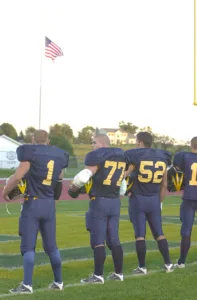
Later in the week, Phillips and his teammates suited up against Southern. That week marked the beginning of a pre-game policy change that was phased in at area schools over the next several seasons.
“The football teams in the Tri-County League came out after the national anthem was played then,” Phillips said. “On that Friday we were going to be on the field for the national anthem, lined up on the goal line with helmets in hand and the flag right in front of you. There’s a picture someone took from the sidelines and had the entire team stretched out across the goal line looking up at the flag and that was a kind of a surreal picture when look at it because it was a monumental moment in our lives.”
BOB SHANSKY
Current Southern Local athletic director and volleyball coach Bob Shansky was the East Liverpool volleyball coach on Sept. 11.
Shansky said the TV was turned on in his classroom just about the time the second plane hit.
“We didn’t know what was going on,” Shansky said. “Everyone in that room was riveted. Then the calls started to come in and parents started to pick their kids up out of concern.”
Shansky was in the unique position where he had children in school at the time and they ended up in his classroom watching the events unfold.
“We were just trying to hear what was going on and trying to explain things to the kids,” Shansky said. “When the news came on about the plane in (Shanksville, Pa.) going down the kids were crying and were worried.”
Shansky said his volleyball match scheduled for that evening was canceled as was school the next day. Only one area high school volleyball match was held that day with Leetonia playing at Southern.
Once back at home, Shansky said his children asked to go play volleyball on the outdoor court at his house and he said he thought it would be a good idea to get their minds off of everything.
“When they were out there this plane flew very low to the ground and shook the whole house,” Shansky said. “I thought it might be the Air Force reserves checking on things like the (Sammis Power Plant) or (the Shippingport Atomic Power Station). It was a scary time.”
Shansky said in the years following he saw East Liverpool and later Southern Local make it a point to teach children about that day.
“I remember a year later we had Danny Ibbs -- the mortician from the Dawson Funeral Home -- come in and talk about getting called into New York City at the time to work. It was horrific. I really felt for him.”
Ibbs was a member of the Disaster Mortuary Operation Response Team and spent a month in service to the families who died in the World Trade Center attack.
BOB SPAITE
Columbiana football coach Bob Spaite, then in his eighth season as Clipper head coach, said it was a moment etched in time like Dec. 7, 1941 or Nov. 22, 1963.
“That was a hell of a week,” the former history teacher and athletic director said. “You talk about looking around and trying to figure out what the hell was going on. That was a bear.”
Columbiana was set to play East Palestine on that Friday. Spaite said he talked to East Palestine coach Brian Blevins over the phone and they agreed to give a joint address to both teams in the far end zone before the game.
“I still have video tape of it,” Spaite said. “I still remember part of his speech and our speech. My speech was almost the same.”
At that the time there was a push by President George W. Bush, other leaders and contemporary cultural icons to continue on with life. In essence, to not let the terrorists win.
“When we talked on the phone we thought if we could help and they would let us get on a bus we would take our guys to Ground Zero,” Spaite said. “We would have loaded up the bus and gone there if that was possible. But it wasn’t obviously. So we took a cure from the president and some of the other NFL guys and stuff. We were not going to let these people dictate our lives. It was tough. I get emotional just thinking about it. It was gut wrenching, but for two hours on a Friday night, we got to put that aside and pretend what we were doing was important.”
Spaite said he was in his athletic director office when he got news of the first plane hitting the towers from Jeff Heaton, a Columbiana athletic department mainstay.
“I thought that was odd,” Spaite said. “It must have been a strange accident.”
Spaite went back to teaching American History after that and Heaton came back later to tell him a second plane had crashed into the towers.
“We stopped what we were doing and we were able to get it on CNN or one of those news shows,” Spaite said.
Spaite said he had a mix of anger and sadness come over him.
“I remember saying they just screwed with the wrong people,” Spaite said.
Of course in the coming days, there was a lot of talking to students and answering questions. There was a lot of concern for those that might be in harm’s way including Spaite’s son who was in the Army reserves at the time.
“My son said we are the bottom of the barrel,” Spaite said. “He said ‘If they have to send my guys, we’re in trouble’.”
Spaite said he had a few former athletes he coached at Southern who were in the military at the time. He also expressed concern for those high school seniors who were on his team who were ready to join.
“A couple guys joined the Marines immediately because of that,” Spaite said. “But there were guys who played for me who I was overly concerned about. I knew they were just trying to get into harm’s way. They were young and had a chip on their shoulder. They’re 10-foot tall and bulletproof. That’s who they were.”
DAN MCKINSTRY
Current East Liverpool volleyball coach Dan McKinstry, then a teacher at East Palestine and a coach at Wellsville, said he remembers having a student teacher at the time and he had just left the classroom to give the student teacher some space to teach on their own.
He said someone approached him in the hall and told him he should turn on the TV because the United States was under attack.
“I immediately went back in the room and we turned the television on and we watched it,” McKinstry said. “There was a lot of questions at the time and the information was pretty sketchy because things were going on and we didn’t know where they were going to hit next.”
It was the most different day he said he ever had in his 36 years of teaching.
He said during the day he called Wellsville athletic director Greg Davis and asked him if he should practice or not.
“Greg told me ‘Why don’t you come down and tell them you’re going to practice but just talk to them. And if you want to practice, practice. If you just want to talk, just talk,'” McKinstry said.
McKinstry said they worked on a couple of things but he said it ended up being more talking and answering questions.
He said it became more emotionally heavy when Wellsville had learned of 1982 graduate Catherine Salter’s death in the attack on the World Trade Center.
“I think it was later that night or maybe the next day they found out about that,” McKinstry said. “That put a whole different light on things for the people of Wellsville because she had been a really good athlete and a really good student. She was just sort of a role model for a lot of the people and a lot of students down there. I realized she had graduated several years earlier but there was a lot of people that knew her and her family. That was a very difficult situation.”
On Saturday, Sept. 15, 2001 McKinstry, the current winningest volleyball in Ohio high school history, won his 400th career match with a win at Southern, but at that time he was more concerned about his oldest stepdaughter just went away to college at Wright State.
“I remember her calling and asking what she should do,” McKinstry said. “I remember saying, ‘Kate, you’re in the safest place you can be because the Wright Patterson Air Force Base has the highest amount of security of almost any of our Air Force bases in the country.'”
He said his wife later went down to settle her down and to spend time with her.
McKinstry said 9-11 was in the background for most of the season and his team often spent portions of practices talking about it.
“It was just something I won’t forget,” McKinstry said.