
Columbiana Library presents ‘Pretty Boy Floyd’ program
Trending
COLUMBIANA -- Some people celebrated Charles "Pretty Boy" Floyd as a "Robin Hood of the Cookson Hills" for his outlaw efforts on behalf of the downtrodden, while yet others --like then-Federal Bureau of Investigation chief J. Edgar Hoover --just labeled him a self-serving thug.
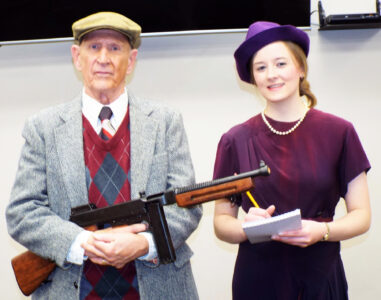
On the 90th anniversary of his death in nearby East Liverpool, Columbiana Public Library hosted a re-creation of an interview that budding reporter Vivian Brown (Megan Austen) conducted with the anti-hero, portrayed by Kenneth Hammontree, two years before on Nov. 3, 1932, somewhere on the edge of the Cookson Hills in Oklahoma.
This would be the only interview ever conducted with Floyd, who was a notorious bank robber and outlaw as he would be killed two years later.
The library's Salchow Room would be packed for the crowd, who watched as Brown (Austin) arrived on that day in 1932 to find a car waiting to fetch her for a long-sought after interview with Floyd, whose family had become fed up with her bothering them.
After being transported around 30 miles away to a remote location, she conducted the interview with Floyd, who discussed a variety of subjects with her, including his crimes, upbringing, religious beliefs and personal life.
During Tuesday's presentation, actors integrated the last two years of Floyd's life into their Living History production.
Floyd spoke of an upbringing in a very poor family, reliant on dirt farming and bootlegging for survival -- much like other disenfranchised Americans who had grown sick and tired of everyday survival while the rich cats prospered on their blood, sweat and tears.
It eventually became apparent when he married and had a small child, that his bootlegging was not enough to support his small family. So he participated in a payroll robbery of a Kroger grocery store in Kansas with two others.
Over the next eight years, Floyd and his colleagues would rob many banks, killing two police officers during the commission of the crimes, and burn hundreds of farm mortgages on the bank floor.
With his anti-federal government sentiment and his Public Enemy No. 1 designation of the FBI, Floyd became a folk hero to the little guys who had lost their home or farm during the Great Depression.
It is estimated that during the commission of Floyd's crimes, more than $800,000 had been stolen during those days. The bulk of it went back to those dirt farmers, local ministers and poor in the communities.
After all, Floyd fancied himself not only a staunch Baptist but also a yellow dog Democrat, which he detailed to Brown. Most notable about Floyd's exploits, Hammontree explained, even though Floyd was lumped in as a gangster among others like Bonnie and Clyde, it was his motivation that put him in a class of his own.
While Bonnie and Clyde's gang targeted the robbery of civilians and small businesses, Floyd's exploits were clearly a little more altruistic. For him, a death during the commission of his crimes was not intentional but just an unfortunate happenstance.
Floyd told Brown for her article years before his death, "I do not rob clerks and farmers who have holes in their shoes and cheap suits. I only rob moneyed men."
Brown never wrote her book about Floyd's life, but did pen a compassionate series of articles for a syndicated news service from that interview, which eventually were published for the Oklahoma News and a few other newspapers days after his death on Oct. 22, 1934, in an East Liverpool cornfield.
When he isn't teaching American history at Genesis Christian Academy in Ashland, Hammontree is portraying one of 28 characters for Living History Productions, including Daniel Boone, Oskar Schindler or Thomas Jefferson.
This program was sponsored by the Friends of the (Columbiana) Library non-profit organization, which assists the library through its volunteer work, fundraising and donations through efforts like its book sales. To join or learn more about the group, visit their page on the library's website at https://columbiana.lib.oh.us