
East Palestine still waiting for disaster declaration
Trending
EAST PALESTINE -- As September rapidly approaches, so does another grim anniversary marking the East Palestine rail disaster. On Sept. 3, seven months will have passed since a Norfolk Southern train derailed and spilled its toxic contents. It will also mark two months since Ohio Gov. Mike DeWine requested a Major Presidential Disaster Declaration from the Biden Administration. Despite pleas from residents and Senators Sherrod Brown (OH-D) and J.D. Vance (OH-R), Biden has made no move toward making the declaration that would give East Palestine access to millions of dollars in federal aid that many say is desperately needed.
In an op-ed published in the Columbus Dispatch one day after an Aug. 14 trip to East Palestine, Vance vented frustration at the lack of federal funds for East Palestine.
"Weeks ago, Gov. Mike DeWine requested a Major Disaster Declaration from the president," Vance wrote. "The Biden administration has ignored Ohio's pleas for help. This is inexcusable. A disaster declaration would guarantee the delivery of resources to save itself."
On July 3, DeWine officially made the declaration request. It came three months after the disaster and on the day a 120-extension granted by the Federal Emergency Management Agency expired -- a second
extension was denied. In his letter to Biden formally requesting the declaration, DeWine wrote that there were "no unmet needs" but rather painted the request as a safety net in the event Norfolk Southern failed to hold up their end of the bargain in regards to recovery and clean-up.
DeWine's verbiage struck a combative chord in those living through the derailment.
"We the people do have unmet needs and we are not safe," said lifelong East Palestine resident Jami Wallace. "We need federal support to ensure the recovery of residents. Economic recovery is needed but should not supersede human health."
Those needs, Wallace said, include more robust testing of the air and surfaces inside of homes, available testing of private wells on land outside the zones set by the responding agencies, and epidemiological testing to track the extent of chemical exposure on residents among other things. So far, Norfolk Southern has committed nearly $70 million to East Palestine, but Wallace said none of the funds have been used to address the real issues in the wake of the derailment.
Motivated by what they viewed as lack of relief from the local, state and federal agencies, Wallace along with other East Palestine residents and those in surrounding communities, created an oversight committee (the Unity Council for the East Palestine Train Derailment) to advocate for the needs of those communities. The Unity Council has been calling for such a presidential declaration for months and took action that call for action on the road. The group first traveled to Columbus in June to apply pressure to DeWine to make the request. The group then took their fight to Capitol Hill in July to gain support of federal lawmakers in Washington and apply the same pressure to Biden.
During the trip to Washington, Wallace and the Unity Council met with Brown. Brown later recounted that meeting in a letter to Biden on Aug. 7, expressing the need for a declaration.
"Representatives from the community shared some of the challenges they continue to face as a result of this devastating derailment," Brown wrote. "Some are still forced to live away from home, others are concerned about the quality of air in their homes or the impact of basement groundwater exposure and many are facing a range of health symptoms and are understandably concerned about the health both now and in the future."
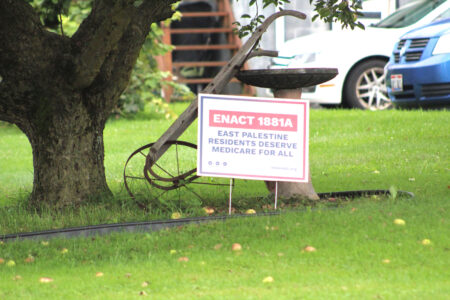
Those symptoms have included persistent nosebleeds, sore throats, rashes and eye irritation as well as digestive, respiratory and neurological issues. The long list of symptoms and the fear of what long-term implications may occur due to the derailment have also sparked to the Unity Council to demand the enactment of Social Security Act 1881a -- a little known provision in the Affordable Care Act. The provision was specifically written for the residents of Libby, Montana after mining operations caused decades of asbestos-related diseases and deaths in the small Rocky Mountain town. The provision allowed Libby residents access to free health care for life and opened the door for other U.S. citizens living through similar "environmental disasters" to be granted the same. The act also gave the Comprehensive Environmental Response, Compensation and Liability Act (CERLA) -- also known as -- Superfund a way to address serious health impacts of contamination CERCLA was created to clean up. The Environmental Protection Agency declared Libby a "public health emergency." It was the first declaration of its kind made by the EPA but it took the agency 10 years to do so.
As for East Palestine, the EPA maintains the water, air and soil are safe. The only concession from the agency has been the surface water, particularly Leslie Run and its tributary Sulphur Run, which the EPA admits are still heavily contaminated with compounds spilled in the derailment but insists are improving despite a visible chemical sheen remaining in both creeks.
Many in the community continue to voice a lack of confidence in the EPA's remediation efforts in East Palestine. All the more reason, insists Jessica Conard, that a Major Presidential Disaster Declaration is warranted. Conard, a member of the Unity Council and, like Wallace, a lifelong resident of East Palestine, said a declaration is not just needed but long overdue.
"The EPA has exceeded their capabilities in East Palestine. We know this because there is still considerable contamination in the creeks," she said. "This contamination runs under our whole town and remains just steps away from hundreds of homes. The lack of response from Biden is irresponsible. He is holding the health and safety of my community hostage by a mere stroke of a pen."