
Salem, county recognized for economic development
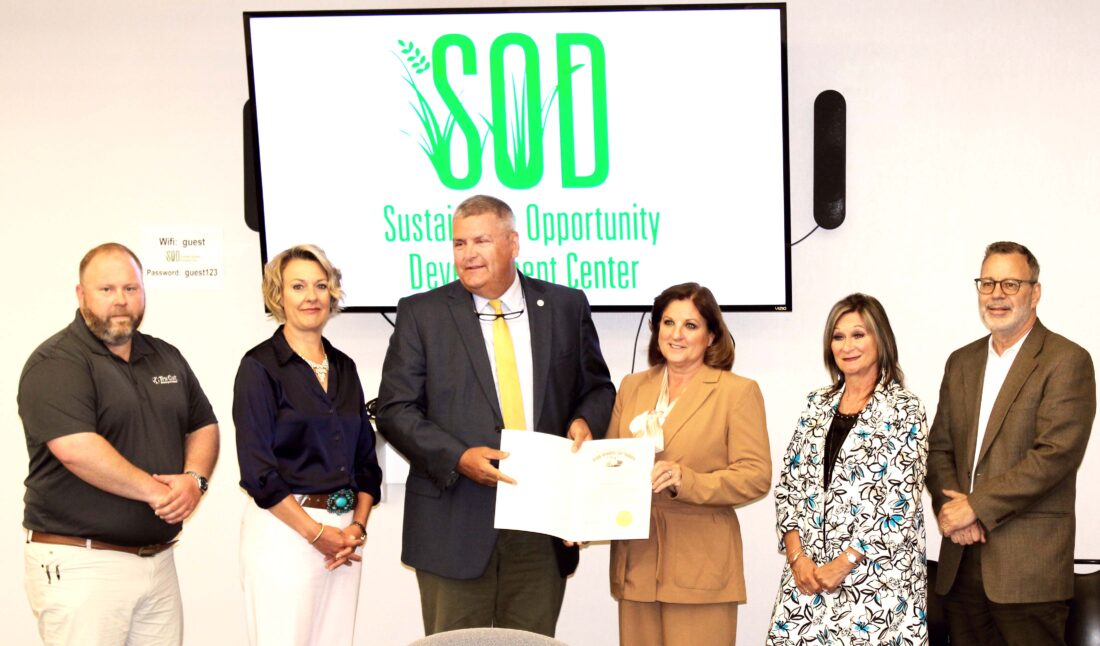
The city of Salem and Columbiana County as a whole received an official proclamation recognizing their achievements in economic development from the Ohio Department of Development Wednesday morning, having recently been named as a top 100 Micropolitan by Site Selection Magazine. The proclamation was presented on behalf of Ohio Governor Mike Dewine and Lieutenant Governor Jon Husted, by Ohio Department of Development Chief of Community Engagement Scott Ryan. Pictured from left are City Councilman and Economic Development Committee Chairman Jake Gano, Sustainable Opportunity Development Center Executive Director Julie Needs, Ohio Department of Development Chief of Community Engagement Scott Ryan, Mayor Cyndi Baronzzi Dickey, Columbiana County Port Authority Executive Director Penny Traina, and Columbiana County Commissioner Roy Paparodis. (Photo by Morgan Ahart)
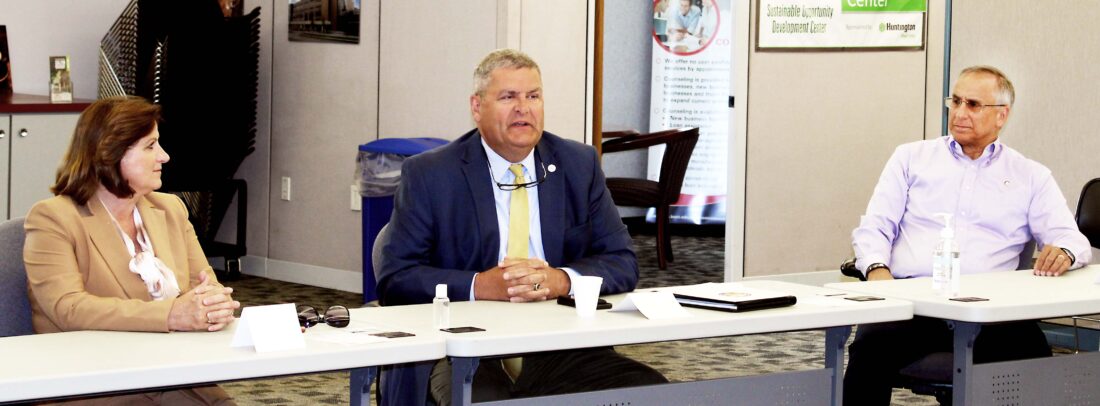
Following Wednesday’s award ceremony, a lengthy discussion was held with city, county and private leaders in economic development in Columbiana County. Pictured from left are Mayor Cyndi Baronzzi Dickey, Ohio Department of Development Chief of Community Engagement Scott Ryan, and City Service Safety Director Joe Cappuzzello. (Photo by Morgan Ahart)
The city of Salem and Columbiana County as a whole received an official proclamation recognizing their achievements in economic development from the Ohio Department of Development Wednesday morning, having recently been named as a top 100 Micropolitan by Site Selection Magazine. The proclamation was presented on behalf of Ohio Governor Mike Dewine and Lieutenant Governor Jon Husted, by Ohio Department of Development Chief of Community Engagement Scott Ryan. Pictured from left are City Councilman and Economic Development Committee Chairman Jake Gano, Sustainable Opportunity Development Center Executive Director Julie Needs, Ohio Department of Development Chief of Community Engagement Scott Ryan, Mayor Cyndi Baronzzi Dickey, Columbiana County Port Authority Executive Director Penny Traina, and Columbiana County Commissioner Roy Paparodis. (Photo by Morgan Ahart)
Following Wednesday’s award ceremony, a lengthy discussion was held with city, county and private leaders in economic development in Columbiana County. Pictured from left are Mayor Cyndi Baronzzi Dickey, Ohio Department of Development Chief of Community Engagement Scott Ryan, and City Service Safety Director Joe Cappuzzello. (Photo by Morgan Ahart)
Trending
SALEM -- Salem and Columbiana County received an official proclamation recognizing their achievements in economic development from the Ohio Department of Development (ODOD) at the Sustainable Opportunity Development Center Wednesday morning.
The proclamation, issued on behalf of Ohio Governor Mike Dewine and Lieutenant Governor Jon Husted, was presented by ODOD Chief of Community Engagement Scott Ryan in recognition of Salem's selection as a top 100 Micropolitan by Site Selection Magazine.
Following the presentation, a lengthy discussion was held with Ryan and several city, county, and private officials who have helped push for economic development in Columbiana County, including: Mayor Cyndi Baronzzi Dickey, City Service Safety Director Joe Cappuzzello, City Councilman and chair of the Economic Development Committee Jake Gano, Columbiana County Port Authority Executive Director Penny Traina, Columbiana County Director of Economic Development Tad Herold, Columbiana County Commissioner Roy Paparodis, SOD Center Executive Director Julie Needs, SOD Center President Goerge Morris, SOD Center Vice President Joe Hovorka, and representatives of Team NEO.
During the discussion officials were invited to share what they felt the strengths and weaknesses of Salem and Columbiana County at large were in terms of economic development, as well as any concerns they wanted Ryan to present at the state level.
Needs cited Salem's greatest asset as a spirit of collaboration between the city and county officials and agencies, placing particular importance on the close collaboration between Salem officials, the SOD center, the county commissioners, and the port authority, as well as direct project support by Team NEO.
"When I say we work as a team I mean that when somebody calls Salem looking for a facility or a space and I can't accommodate it, the first person I call is Penny [Traina] because we want to keep them in the county. We feel what benefits Salem also benefits the county, and what benefits the county also benefits Salem, and I feel that's where a lot of our success comes from," said Needs.
Herold and Traina echoed Needs' sentiments, with Herold noting that such a spirit had not always existed. As a result in the past the county did not have the capacity or collaboration required to capitalize on economic development opportunities.
"It takes a certain amount of capacity, but it also takes having the right people in the right positions to throw away the fences and the egos, and to be able to work together and trust one another. I wish we had that capacity across the entire county, Salem's the only municipality that has either the capacity, or the foresight to put forward someone dedicated to economic development, because we can't do everything for everyone at the Office of Economic Development and the Port Authority," said Herold.
Needs also highlighted the construction of the SOD Center's workforce training center, and the re-skilling and upskilling possibilities it provides the local work force, and the soon tho be established third party commercial building department that will serve Salem and the city of Columbiana.
Dickey said that another factor was an increase in positivity regarding development projects that she has experienced firsthand over her lifetime. Dickey said that in the past when presenting such ideas she would face pessimistic outlooks and unwillingness to cooperate. However, now projects are met with optimism, often receiving not only encouragement from leadership, but options on how the projects might be completed or initiated.
As far as roadblocks faced by Salem and the county, Needs and Dickey both cited the sourcing of properties for development. Dickey noted that while there are resources available to assist in the purchase of properties, there are few for the development of property planning, and optioning properties for purchase once the sale of all required adjacent properties for a project have been completed.
"There are grants, and low interest, or no interest loans to buy sites, but there is nothing out there I've been able to find to get options on properties so we can move forward and purchase them when we have everything in places," Dickey said. "You can't just jump in and start buying properties and end up with some big space in the middle like a donut that says no; and that's what's really frustrating. We all have these dreams, and everyone is saying let's do that, and we see all this money being offered for those steps down the road, but we just can't get that first step in the door."
Gano also cited the city's ongoing issues with traffic congestion, particularly semi-truck traffic as an issue that would only become more severe as the city and county continues to grow, these traffic issues will only continue to be exacerbated.
"As you continue to build industrially, you're bringing a lot of trucks in and especially with the amount of growth in our downtown area, it can wreak havoc on buildings, and puts a choke on everything," said Gano.
Gano said that while the city is fairly well connected by state routes, all the routes that run through the city are only two-lane roads. Gano also said that there had been plans in the late 1960s to connect U.S. Route 62 from Canton through I-77 and connecting to state route 11. But the extension had reached as far as Alliance, and a "10-mile stretch" between the two cities had never been completed, nor had "a 3.5 to 4 mile stretch to the north of Salem" ever been properly connected. Gano argued that should those plans be fully completed by the Ohio department of Transportation it would drastically reduce the congestion issues. Gano also cited the uncompleted plans to expand U.S. Route 30 through the area as a potential path to alleviating the issue.
"The completion of one or both of those would be wildly helpful as far as being able to get some unnecessary traffic out of town and diverted," said Gano.
Dickey echoed Gano's sentiments regarding Route 30, noting that she felt "Columbiana County, and especially this area, have been extremely patient." Dickey said that the expansion has been in the planning phase for 57 years, joking she knew how long it had been because the plans were originally released when she was in third grade, and the plan would have seen to route proceed through her bedroom in her childhood home.
"If not now, when are they ever going to put us in the focus?" she said.
Dickey argued that Salem is often cited as a major corridor for the transportation of hazardous materials.
"They cite us all the time as being the place where nuclear waste, or toxic waste are trucked through the area, and they're being trucked through on these little two-lane roads. That's not a great look, that's not really safe. We need to have better roads to get things like that through there if that's where they're going to go," said Dickey.
Ryan said that while he would forward their concerns to his contacts at ODOT, he encouraged officials and residents to write letters to share their concerns with ODOT directly, and with state legislators.
The meeting concluded with Herold, Traina, Needs, and Dickey all expressing frustration at a lack of clarity and transparency regarding the application process for the Appalachian Community Grant. Herold said that several changes had been made from what was originally described and intended for the grant throughout the process, and urging Ryan deliver a request for further clarity and a reminder of the originally stated intent of the grant to be a grassroots grant to allow for local administrations to decide what was most needed in their communities.