
Despite never living in Columbiana County, William McKinley’s connection to the area remains strong long after his assassination
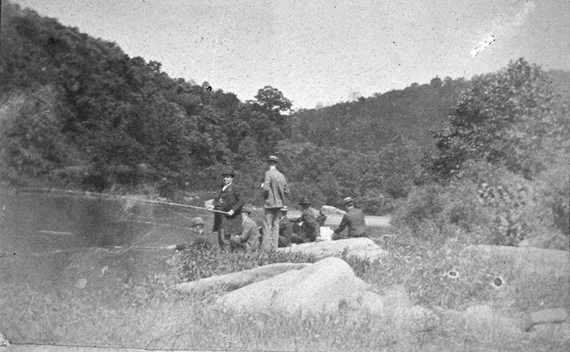
William McKinley (with the fishing pole) enjoyed visiting Columbiana County and would fish in Beaver Creek. This photo is dated 1891. (Photo courtesy the East Liverpool Historical Society.)
Editor’s note: The following column is the first of a new monthly series provided by the Lisbon Historical Society highlighting historical topics across Columbiana County.
***
More than 125 years since his death, William McKinley’s connection to Columbiana County remains remarkably strong, especially considering that he was not born here and never actually lived in the county.
Born in Niles in 1843, McKinley lived most of his life there or in Canton where he would be enshrined after his death.
In his early life, like many, McKinley volunteered for Civil War service at 18, joining the 23rd Ohio Volunteer Infantry, a regiment that boasted of Major Rutherford B. Hayes who made a name for himself in the political aftermath of the war.
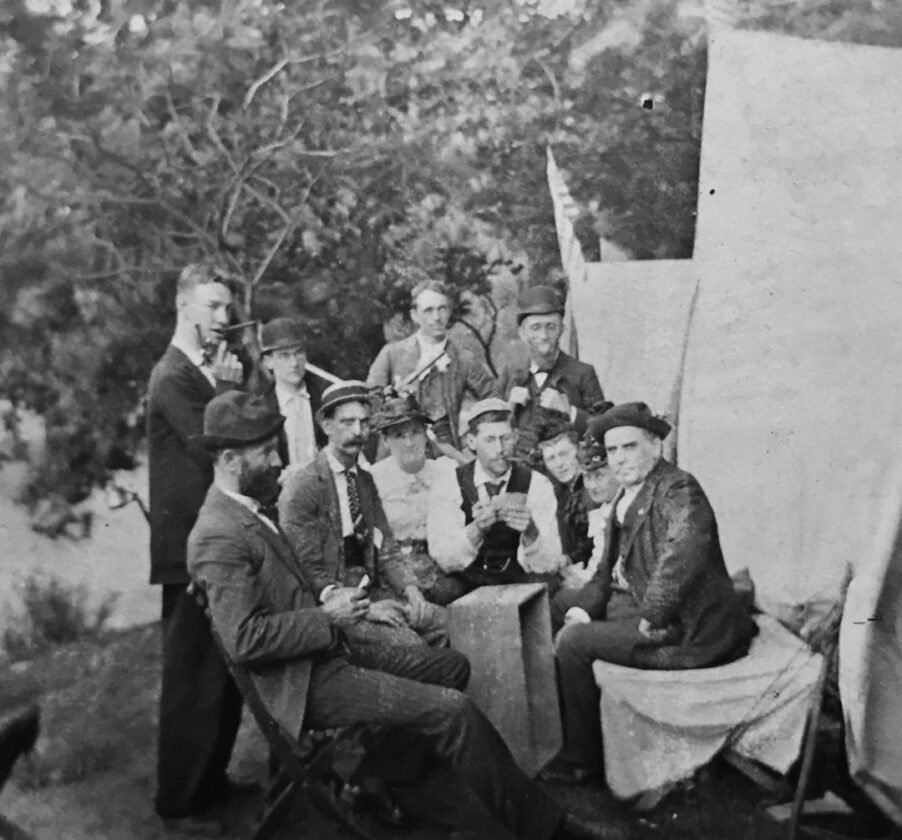
William McKinley, front right, playing cards with friends along Beaver Creek near Grimms Bridge. The man standing at the left with the gun is likely a member of Governor McKinley’s protection detail. (Photo courtesy the East Liverpool Historical Society.)
Young McKinley was initially a lowly private who as the war progressed rose to 2nd lieutenant and to captain in July 1864. Most of his duties involved serving as commissary sergeant which would keep him out of the front line. At the end of his service in July 1865, McKinley received a brevet (honorary) designation as a Major in the regiment, a recognition that he cherished.
The McKinley family had connections to Lisbon. His grandfather owned a farm there prior to the family moving to Niles. Upon entering the world of politics after receiving a law degree, McKinley paid close attention to the perceived needs of his potential supporters and their families. Elected to the House of Representatives in 1876 after serving as the Stark County prosecuting attorney. During his years in the House, McKinley was a strong supporter of tariffs to protect Ohio’s rapidly growing industries and secure high wages for American workers. As chairman of the House Ways & Means Committee he was the principal sponsor of the McKinley Tariff of 1890 that raised tariffs to their highest rate ever.
After losing his seat in 1890, McKinley availed himself of the services of another powerful figure with a Columbiana County background, Marcus Hanna. Hanna helped McKinley secure his election as Governor of Ohio in which he served two terms (1892-1896).
By 1896, McKinley and Hanna had as their goal the U.S. presidency and went about securing business campaign contributions that would make it possible. Their opponent in 1896 was the gifted orator William Jennings Bryan, who favored doing away with the gold standard for the dollar that Republicans feared as inflationary.
Recognizing Bryan’s advantage in speech making, McKinley remained at his home in Canton and conducted what was called the “front porch campaign.” McKinley gave speeches promoting the benefits of the gold standard and portraying Bryan as a dangerous radical. The campaign proved very successful. McKinley became the first Republican to achieve a popular majority since 1872 and beating Bryan 271 to 176 in the electoral vote.
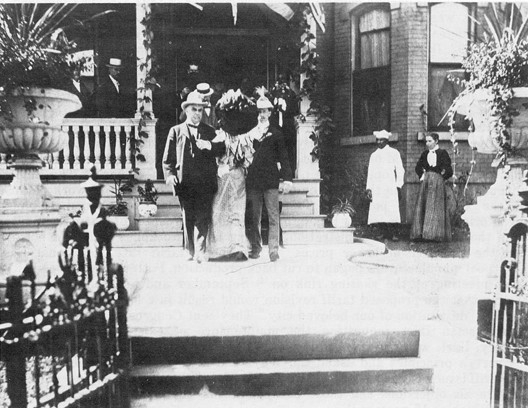
William McKinley and his wife stand in front of the John N. Taylor home on Sixth Street in East Liverpool. Taylor was an executive in the pottery industry. The photo is dated 1899. (Photo courtesy the East Liverpool Historical Society.)
Personally hostile to the war fever that was developing due to Spain’s abuse of Cuba and Puerto Rico, McKinley was slowly forced to change. The Secretary of the Navy Theodore Roosevelt even described the President as having the backbone of a “chocolate eclair.” However, the destruction of the Battleship USS Maine in Havana Harbor in February 1898, killing 266 men, pivoted McKinley to the side of armed intervention. On April 20, Congress approved the use of armed force to secure Cuban independence. It was followed five days later by a formal declaration of war.
The Spanish-American War was described by Secretary of State John Hay as a “splendid little war” that saw the defeat of Spain in Cuba, the Philippines and Puerto Rico in less than four months. At its conclusion the United States was a world power.
In 1899, McKinley and his wife made what would be their final visit to Columbiana County when they stayed at the East Liverpool home of pottery manufacturer, John N. Taylor. While there, they toured several local improvements including the new Chester Bridge. The tour was done in what had been McKinley’s carriage that he had gifted to Taylor for his support in the 1896 campaign.
McKinley was renominated for a second term and again faced William Jennings Bryan as the Democrat’s candidate. In the 1900 campaign, Theodore Roosevelt would be McKinley’s running mate.
The electorate was pleased with the outcome of the war and general U.S. prosperity and responded by giving McKinley higher margins of victory in both popular and electoral votes. He was expected to have an uneventful second term but in September he attended the PanAmerican Exhibition in Buffalo, N.Y. At a reception on Sept. 6, 1901, he was shot twice by anarchist Leon Czolgosz. McKinley died Sept. 14 of gangrene. Czolgosz was tried and electrocuted Oct. 19, 1901.
This monthly column is provided by the Lisbon Historical Society. This submission was written by Timothy R. Brookes of the East Liverpool Historical Society. His email is timothybrookeslaw@gmail.com.
-
- William McKinley (with the fishing pole) enjoyed visiting Columbiana County and would fish in Beaver Creek. This photo is dated 1891. (Photo courtesy the East Liverpool Historical Society.)
-
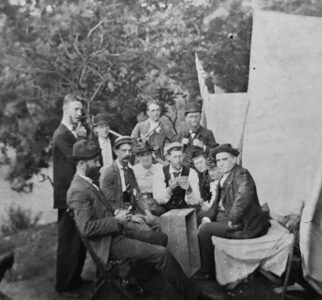
- William McKinley, front right, playing cards with friends along Beaver Creek near Grimms Bridge. The man standing at the left with the gun is likely a member of Governor McKinley’s protection detail. (Photo courtesy the East Liverpool Historical Society.)
-
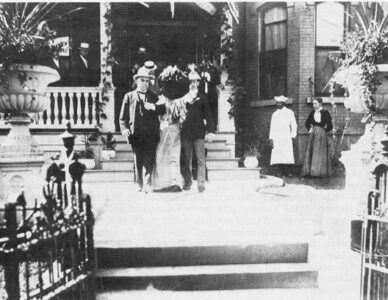
- William McKinley and his wife stand in front of the John N. Taylor home on Sixth Street in East Liverpool. Taylor was an executive in the pottery industry. The photo is dated 1899. (Photo courtesy the East Liverpool Historical Society.)